Postgraduate
Postgraduate
The Master of Science in Electrical Engineering aims to train graduates who know state of the art in a chosen area of specialization and have the necessary skills to contribute to the scientific and technological development of electrical engineering through the creation of knowledge and the development of research and technological innovation.
Graduate Profile
The Master of Science in Electrical Engineering aims to train graduates who know state of the art in a chosen area of specialization and have the necessary skills to contribute to the scientific and technological development of electrical engineering through the creation of knowledge and the development of research and technological innovation.
This training enables graduates to further develop in one or more of the disciplinary areas of the program, namely: High Voltage, Electrical Machines and Drives, and Energy and Power Systems.
At the end of the program, the graduate will have the following competencies:
General Transversal capabilities:
1. To act with high professional, social and ethical standards, acting responsibly in the exercise of research or technological development for the benefit of society.
2. To carry out research or innovation projects within the field of Electrical Engineering, or in a multidisciplinary context, under the guidance of a research professor, to expand their knowledge and contribute to new solutions.
3. To communicate methodologies, results, and conclusions effectively, orally, and in writing in order to contribute to the development of the discipline.
Discipline-specific competencies:
1. Design and execute laboratory activities or simulations that can validate the working hypotheses of a research project.
2. Design and implement solutions to problems in the field of electrical engineering using mathematical-computational modeling and integration of technologies in electrical systems and to carry out applied research and innovation.
3. Develop modeling, control or decision-making strategies in electrical systems under unpredictable conditions to improve their performance.
Study Plan
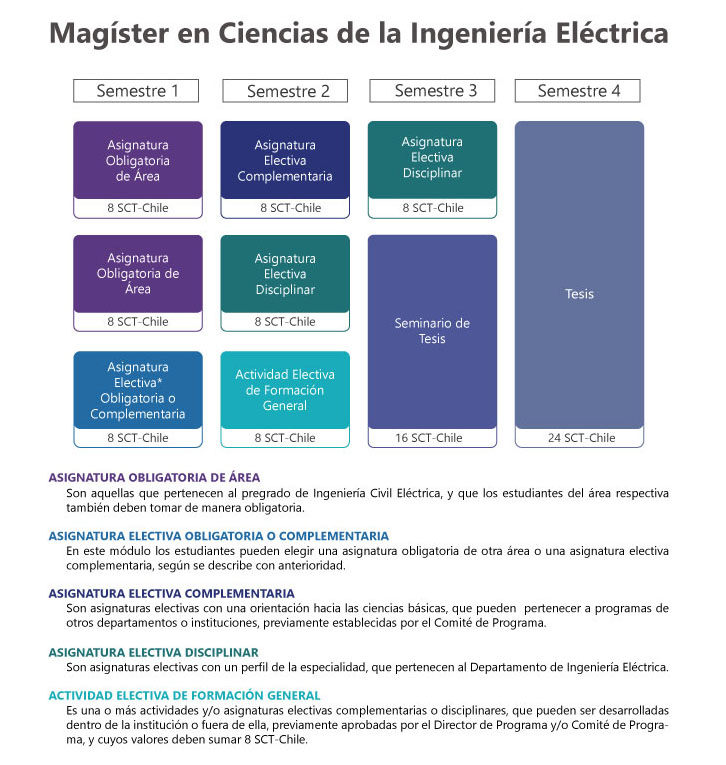
- Compulsory subject areas: compulsory courses that belong to the Civil Electrical Engineering undergraduate program, and that students of the area must also take.
- Complementary elective subjects: these are elective subjects with an orientation towards basic sciences, which may belong to programs of other departments or institutions previously established by the Program Committee.
- Elective subjects (compulsory or complementary): in this module, students may choose a compulsory subject from another area or a complementary elective subject, as described above.
- Disciplinary elective subjects: these are elective subjects with a specialty profile, which belong to the Department of Electrical Engineering.
- General training elective activity: These are (one or more) complementary or disciplinary elective activities or courses. They can be developed within the institution or outside it, previously approved by the Program Director and Program Committee.
Entry Requirements
Students applying to the Program must meet the following entry requirements:
1. To have obtained an academic degree whose content and duration of studies are equivalent to those required to obtain the degree of Bachelor of Science in Electrical Engineering or Bachelor of Electrical Engineering from UTFSM.
2. To declare their interest in pursuing a career in one or more of the areas offered by the Program through a letter of intent.
3. To have passed courses or have verifiable experience in the area(s) of specialty in which the student wishes to pursue studies.
4. To rank in the top 30% out of the students of their graduating class.
Observations:
An intermediate level (Level B1) of English proficiency is recommended for entry into the Program.
Classes are mainly in Spanish; therefore, students need to have the necessary communicative skills to understand and communicate effectively.
Note:
For each of the points mentioned above, the Program establishes an evaluation mechanism outlined in its Internal Regulations.
Application
To apply for this Postgraduate Program, please contact the University’s General Direction of Research, Innovation and Graduate Studies where you can find information regarding the application to our program (including addresses, documentation, costs, application dates, etc.).
Once the applications are received, they will be sent to the Postgraduate Coordinator of the DIE, who will submit them to the MCIE Program Committee. This Committee is in charge of reviewing the applications for admission, suggesting tutors and possible leveling courses.
Program Graduates
The program so far has 30 graduates.
Graduates in the last 9 years:
| Graduation Year | NAme | Area of specialization | Theme | Thesis Director | Thesis Co-director |
|---|---|---|---|---|---|
| 2013 | Ignacio Aravena Solís | Sistemas de Energía y Potencia | Representación discreta de variables independientes multi-dimensionales en la operación de sistemas eléctricos de potencia para estudios de mediano y largo plazo. | Esteban Gil | |
| 2013 | Ricardo Gálvez Cubillos | Sistemas de Energía y Potencia | Estudio dinámico de SEP con generación eólica por medio de análisis de bifurcaciones. | Héctor Pulgar | |
| 2013 | Rodrigo Wetzel González | Sistemas de Energía y Potencia | Análisis del impacto de la suficiencia energética de una mayor penetración de energía eólica en el SIC. | Esteban Gil | |
| 2013 | Margarita Norambuena Valdivia | Máquinas y Accionamientos Eléctricos | Control dual aplicado a un convertidor multinivel Flying Capacitor. | Pablo Lezana | |
| 2014 | Horacio Silva Saravia | Sistemas de Energía y Potencia | Análisis de la ubicación de volantes de inercia considerando el desempeño dinámico del sistema de potencia. | Héctor Pulgar | |
| 2015 | Alex Santander Guerra | Máquinas y Accionamientos Eléctricos | Análisis y compensación de fenómenos no lineales en convertidores multicelda. | Jorge Juliet | |
| 2015 | Javier Toro Cabrera | Sistemas de Energía y Potencia | Evaluación sistémica del ingreso de centrales eólicas en la operación de corto plazo de un sistema eléctrico de potencia. | Esteban Gil | |
| 2016 | Simón Veloso Rivera | Sistemas de Energía y Potencia | Reducción de orden para modelos dinámicos de parques eólicos. | Esteban Gil | |
| 2017 | Matías Urrutia Ortiz | Máquinas y Accionamientos Eléctricos | Esquema de balance local de tensiones de condensadores para convertidores modulares multinivel mediante PWM. | Andrés Mora | |
| 2019 | Raúl Cárdenas Zamorano | Sistemas de Energía y Potencia | Planificación de largo plazo de un sistema eléctrico de potencia utilizando descomposición lagrangiana en modelos de programación estocástica en dos etapas. | Esteban Gil | |
| 2019 | Luis Orellana González | Alta Tensión | Medición de radiofrecuencia mediante antenas para el diagnóstico complementario en dispositivos plasma foco. | Jorge Ardila | Roger Schurch |
| 2019 | Elizabeth Paduro Williamson | Sistemas de Energía y Potencia | Representaciones alternativas de la demanda para la integración de energías renovables a la planificación de la expansión de transmisión. | Esteban Gil | Ignacio Aravena |
| 2019 | Joaquín de la Barra Toloza | Sistemas de Energía y Potencia | Modelo basado en confiabilidad para la localización y coordinación óptima de dispositivos de protección en redes de distribución. | Alejandro Angulo | Esteban Gil |
| 2020 | Christian Soto Ruiz | Sistemas de Energía y Potencia | Desarrollo de una formulación eficiente para la programación de la generación de corto plazo en sistemas hidrotérmicos | Esteban Gil | |
| 2020 | Horacio Enero Saavedra | Sistemas de Energía y Potencia | Optimización de la localización y tamaño de sistemas BESS con el fin de mejorar la respuesta de estabilidad de pequeña señal | Víctor Hinojosa | |
| 2020 | Pablo Donoso Daille | Alta Tensión | Análisis de descargas parciales en árboles eléctricos bajo excitación alterna de muy baja frecuencia mediante técnicas de análisis de series de tiempo no lineales | Roger Schurch | Jorge Ardila |
| 2021 | Carlos Cárdenas Bravo | Sistemas de Energía y Potencia | Caracterización de modos de falla en módulos solares fotovoltaicos basado en su respuesta eléctrica | Patricio Valdivia | Antonio Sánchez |
| 2021 | Pablo Briceño Navarro | Máquinas y Accionamientos Eléctricos | Implementación convertidor fuente de corriente para vehículos eléctricos, utilizando celdas de combustible | Antonio Sánchez | |
| 2021 | Diego Jiménez Bustamante | Sistemas de Energía y Potencia | Diseño de un esquema de solución robusto-adaptativo para el problema de predespacho de unidades de generación | Alejandro Angulo | Esteban Gil |
| 2021 | Nicolás Medina Poblete | Alta Tensión | Uso de algoritmos metaheurísticos en la técnica de análisis de potencia espectral (SPCT) para optimizar la separación de descargas parciales y ruido eléctrico | Roger Schurch | Jorge Ardila |
| 2021 | Juan Pablo Sepúlveda Adriazola | Sistemas de Energía y Potencia | Robust Co–optimization of Droop and Affine Policy Parameters in Active Distribution Systems with High Penetration of Photovoltaic Generation | Alejandro Angulo | Esteban Gil |
| 2021 | Guillermo Huerta Soto | Máquinas y Accionamientos Eléctricos | Técnicas de modulación y control para convertidores híbridos basados en condensadores flotantes | Margarita Norambuena | Andrés Mora |
Contact
- +56 32 265 4268
- +56 32 265 2925

Postgraduate management and programs
- +56 32 265 4395

Department of Electrical Engineering
Program Director: Esteban Gil Sagás