11 - August - 2022
By: Claudia Márquez Rojas, Journalist. General Directorate of Communications.
This high-tech equipment makes it possible to analyze with high precision the operation of photovoltaic panels, in a controlled environment and with conditions similar to those of the desert.
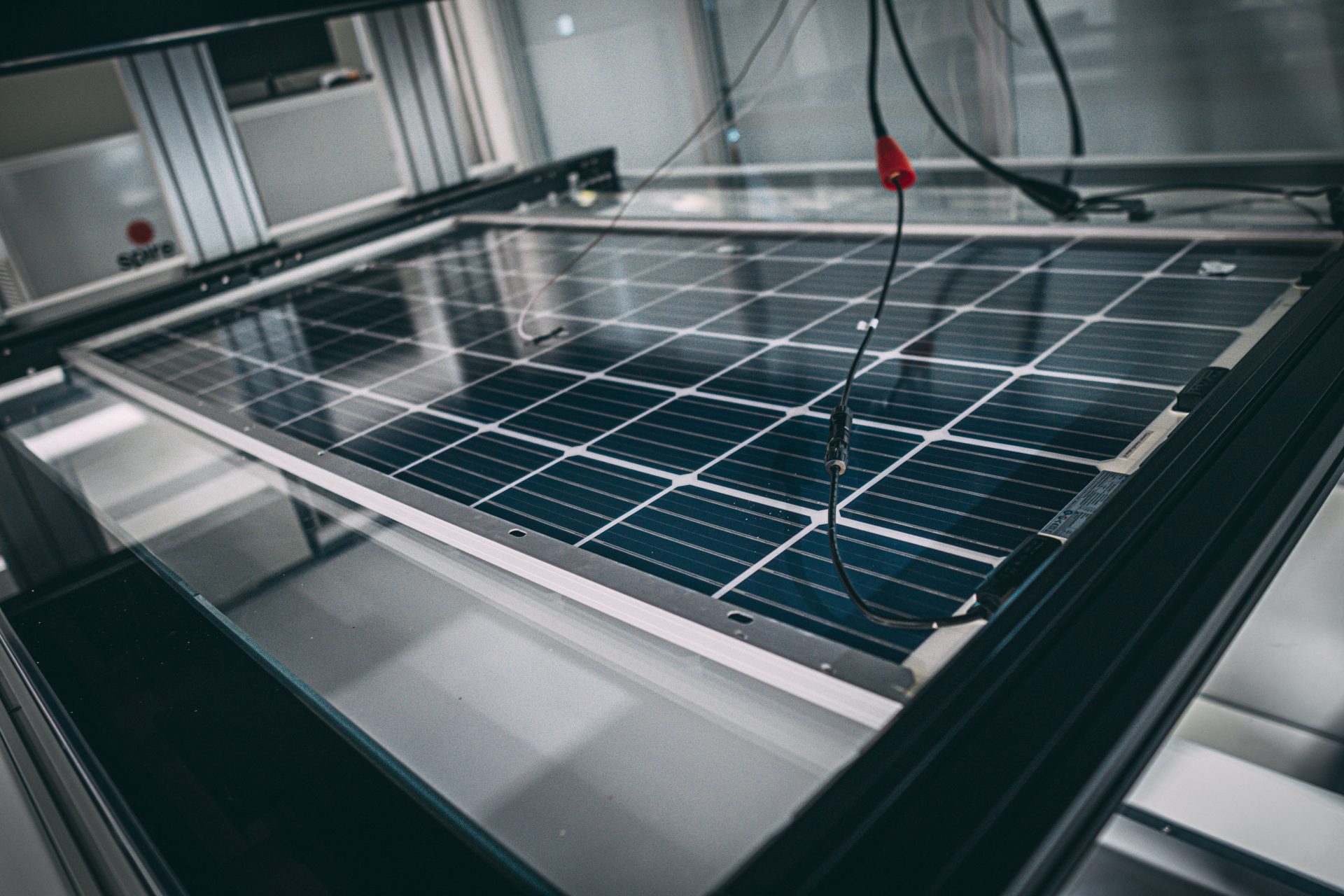
The Federico Santa María Technical University has innovative equipment that will improve research capacities in the field of photovoltaic solar energy in our country. This is the Solar Flasher A+A+A+ Simulator equipment with bifacial capacity, unique in South America, which is installed in the premises of the Solar Energy Laboratory, on the San Joaquín Campus.
This simulator facilitates testing under controlled conditions of photovoltaic technologies, allowing a series of studies on these panels, such as evaluating performance, temperature coefficients, estimating degradation levels and verifying compliance with technical specifications, among others. .
This first level equipment was financed by the National Research and Development Agency (ANID) through the FONDEQUIP project N°EQM200183 “Indoor photovoltaic measurement and monitoring station-solar simulator”, developed by the USM with the support of the Pontifical University Catholic University of Valparaíso, University of Antofagasta, Andrés Bello National University, University of Concepción, University of Chile, Laborelec Latin America, ATAMOS-TEC and Fraunhofer Chile Research.
The academic from the Department of Electrical Engineering of the USM and person in charge of the project, Dr. Patricio Valdivia, explains that “this simulator is a team of collaborative use for all the entities associated with the project, both universities that work on solar issues, and institutions of I +D, which ensures a high level of use. On the part of our University, the departments involved in the project are the Department of Electrical Engineering, Mechanical Engineering, Electronics and Physics”.
Functioning
How does this solar simulator work? As Dr. Valdivia explains, “the equipment emits a beam of light for a very short time, around 100 milliseconds, but with a high solar spectrum, making it possible to carry out analysis in a very short time prior to the significant increase in temperature in the panel. With this technology, we can do simulations and analyzes with environmental and solar radiation conditions similar to those of the desert.”

For his part, the academic from the USM Department of Mechanical Engineering, Dr. Rodrigo Barraza, comments that “the radiation emitted by this equipment is similar to solar radiation, but since it is obtained through lamps, we can control its intensity, which allows us, for example, to analyze the operation of the photovoltaic modules with respect to whether it meets the standard indicated by the manufacturer, to compare how much efficiency it loses over time, issues of fouling and failures”.
Dr. Barraza adds that these studies are not feasible without this simulator, since “the behavior of photovoltaic technology is affected by temperature, so in nature it is not possible to obtain the necessary conditions for this analysis, since operational temperature depends on a range of environmental factors. On the other hand, the equipment is a climate-controlled chamber and the lighting it receives is like the flash of a photographic camera, maintaining a stable temperature”.
Worldwide research
For the USM academics, this equipment will bring significant progress in the results of current and future research related to photovoltaic technology.
“This team will strengthen the USM solar energy research group, created in 2017 and which has been specializing in the operation and maintenance of photovoltaic plants. We have been awarded a series of projects related to this line, such as Fondef Idea ID: 21I10424, where we are evaluating the degradation of solar modules in Chilean desert conditions”.
“The precision of this equipment is very important, it will allow us to carry out research at the highest level, and without a doubt consolidate the solar energy group and make it a benchmark”, explains Dr. Barraza.
This analysis is shared with Dr. Valdivia, who also adds that with this team “we will be able to increase and deepen high-level research, raising the type of publication, its quality and its impact, both nationally and internationally. world. In addition, we will be able to increase our collaborations with Chilean institutions that do research in solar energy, as well as carry out specialized consultancies on these issues, opening a field of industrial relations with energy generating companies and promoting the development of this clean technology in our country”, he concluded. .
The new solar simulator will be inaugurated next Friday, August 12, in a ceremony held at the USM Electromobility Laboratory on the San Joaquín Campus.